Entering the South African site of the "World's Giant Eye"
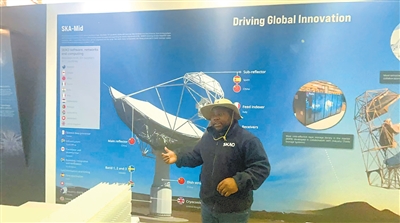
Oscar Moyo, head of the SKA medium-frequency telescope assembly, integration and verification department, introduced the project.
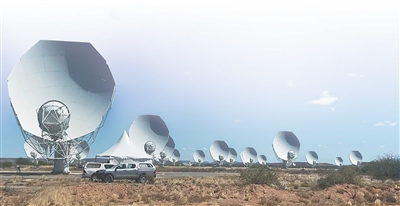
The dish antenna array at the SKA South African site. All the above pictures were taken by our reporter Zou Song.
The stars whisper secrets, and the wilderness listens. Deep in South Africa's Karoo Desert, dozens of radio telescopes, arranged in a spiral arm, survey the skies and explore the mysteries of the universe. This is China's first major international scientific project, the Square Kilometer Array (SKA). Jointly funded and operated by multiple countries, the SKA is the world's largest radio telescope with a comprehensive aperture, known as the "Giant Eye of the World." Recently, reporters visited the project's South African site and interviewed several scientists and engineers to learn about its latest construction progress and scientific discoveries.
In a quiet place, a giant umbrella is erected to support the sky
Dish antennas achieve stronger signal reception and connection through array layout
In South Africa, "Karou" means "Silent Place." This desert and semi-desert region covers approximately 400,000 square kilometers, with scattered villages and towns often separated by hundreds of kilometers. This desolate and lonely landscape, shaped by nature, also creates excellent conditions for astronomical observation.
The SKA utilizes a dual-site approach, with a low-frequency array located in western Australia and a medium-frequency array centered in South Africa and extending to eight countries in southern Africa. "South Africa and Australia are currently among the few astronomical observation sites with minimal light pollution, which was a key reason for the SKA's selection," said Willy Benz, President of the International Astronomical Union. "Deep space exploration on Earth's surface presents multiple challenges. Light, sound, electromagnetic signals, and buildings can all affect observations, so we need to shield ourselves from all physical interference as much as possible."
The South African site will consist of thousands of 15-meter dish reflectors distributed over a 3,000-kilometer radius, interconnected by radio interferometry. To date, the first phase of construction for both the South African and Australian SKA sites has completed its interim goals. Sixty-four antennas have been installed at the South African site (the lead project, the MeerKAT radio telescope), and another 15 antennas designed and built by China are currently being assembled on site.
Special regulations apply to entering the SKA site in South Africa. Upon departing from the small town of Carnarvon, nearly 100 kilometers away, all personnel must observe "radio silence." All cell phone signals, Wi-Fi, Bluetooth, and hotspots must be turned off. Reporters followed the convoy toward the SKA project site, encountering endless wilderness along the way. When the towering dish antennas came into view in the distance, everyone exclaimed, "Finally, a discovery!" The closer they got, the more antennas appeared, towering like giant white umbrellas, silently rising above the wilderness.
"When viewed from above, they form an array with arms extending counterclockwise from the center. The closer you get to the center, the denser the antennas are, and the farther out, the farther apart they are," Lindsay Magnus, director of the SKA Medium Frequency Telescope, told reporters. "This array layout is designed to provide better signal coverage, enabling better reception and connectivity at different frequencies and in different directions."
Walking into the dish antenna array, each antenna bracket is about 11 meters high, supporting the main reflective surface with a wingspan of 15 meters. These "big dishes" sometimes turn and pitch in unison at a set rhythm, making a "squeak...squeak..." sound of mechanical operation, and sometimes "disperse" and some rotate in specific directions, while others keep the receiving surface upright and no longer move, as if they are in a resting state.
Okert, the SKA South Africa project's chief mechanic, led reporters to the base of dish antenna numbered "001" and opened the hatch, revealing a dense network of control circuits. "The antenna can be controlled manually or automatically tracked through a background program," Okert explained, manually steering the antenna's receiving surface. "The SKA's greatest advantage is the controllable signal receiving surface over a much larger area. In the initial phase, we will install 197 dish antennas, with thousands more to form an even larger array later."
In addition to the numerous radio antennas at the project site, a complex nestled behind a hilly landscape houses a data center and supporting facilities, serving as the SKA's "nerve center." Magnus said, "The SKA generates a massive amount of data, averaging approximately 8TB per second. This data is then transmitted to supercomputers for processing via dedicated broadband. Ultimately, this data will be shared with scientists from many countries. This is a global project."
Multiple countries join hands to explore the mysteries of the universe
SKA demonstrates wide-area surveys, high sensitivity, and high resolution
The SKA is China's first major international scientific project in which it fully participates and plays a significant role. In 1993, ten countries, including China, jointly initiated the SKA initiative. In 2011, China and seven other countries co-founded the international SKA Organization, which transitioned to an intergovernmental organization, the SKA Observatory, in 2021, officially becoming a global scientific collaboration.
Philip Diamond, Director General of the SKA Observatory, said: "This is a unique organization spanning five continents and the Northern and Southern Hemispheres. We need not only infrastructure and data transmission at the observation sites, but also data processing and analysis at major computing centers around the world. We have established a mechanism for all countries to jointly build and share this next-generation scientific platform."
Radio telescopes are telescopes that receive and observe radio waves. Compared to optical telescopes, they offer greater penetration, higher resolution, and more stable data collection, making them one of the primary instruments for current cosmic observation. The Five-hundred-meter Aperture Spherical Radio Telescope (FAST), known as China's "Sky Eye," represents the current state of the art in single-aperture radio telescope technology, with a sensitivity capable of detecting signals 10 billion light-years away. The SKA, on the other hand, is an aperture-synthetic radio telescope that uses a combination of multiple antennas to form an equivalent large-aperture observation, effectively turning Earth into a "planet-scale lens" for observing the starry sky. The square kilometer-level equivalent receiving area translates to exceptionally high sensitivity and scientific discovery capabilities, enabling the discovery of numerous extremely weak signals that were previously undetectable.
"As a representative of the new generation of radio telescope technology, SKA has the characteristics of wide-area surveys, high sensitivity, high resolution, and faster observation speed." Ma Yinzhe, director of the Department of Astrophysics at Stellenbosch University in South Africa, told reporters, "SKA is a constantly developing project. Some early results have proved that it has greatly advanced human vision." MeerKAT has achieved a series of observational results: in 2022, it synthesized a photo of the center of the Milky Way for the first time, clearly showing the picture of a spherical supernova explosion; in February of this year, a giant galaxy more than 32 times the size of the Milky Way was discovered, which will help to further understand the origin and evolution of large galaxies in the universe; in October of this year, neutral hydrogen signals were detected in 11 galaxies more than 4 billion light-years away from the Earth. Through this signal, scientists can "hear" the movement, aggregation and star formation process of gas in galaxies billions of light-years away.
"For millennia, humans have explored the universe using various methods, piecing together a cosmic puzzle. One of our tasks is to integrate these pieces and gain a clearer understanding of the evolution of the universe," said Michaela Griffiths, Chief Scientist of the SKA. "The interconnectedness of cosmic matter, the influence of magnetism and gravity, the motion of pulsars, and new astronomical research methods are all goals that the SKA project aims to achieve."
China's strength helps build research
SKA and FAST complement each other's strengths and expand cooperation in multiple fields
In the SKA project exhibition hall, a backdrop featuring national flags from various countries participating in the construction of the dish antennas stands out, with the Chinese flag appearing most frequently. Oscar Moyo, Head of the SKA Medium-Frequency Telescope Assembly, Integration, and Verification Department, stated that China is a key contributor to the project. China provided the SKA's medium-frequency antenna structure, including the main and secondary reflectors, and worked with the verification team to ensure the antenna structure meets its objectives. In the future, China will also provide 64 antennas as in-kind contributions. China is also a key participant in the SKA Regional Science Center.
The China Electronics Technology Group Corporation (CETC) Network and Telecommunications Research Institute (CETC) is the first-tier contractor for the SKA's ongoing medium-frequency antenna structure, responsible for its design, manufacturing, transportation, integration, and commissioning. Magnus highly praised the Chinese medium-frequency antenna. He explained that the dish's main reflector is composed of 66 individual panels, each 3 meters on a side. Each panel has been adjusted with submillimeter precision to ensure a smooth reflector surface, and each panel has a specific curvature depending on its location. High precision is crucial for collecting radio waves from space and ensuring the achievement of observational objectives.
In May of this year, Tsinghua University, in collaboration with astronomers from Italy, Australia, Germany, and other countries, used FAST and MeerKAT to conduct high-precision observations of globular clusters in the Milky Way. The observations produced a clearer map of the Milky Way's magnetic field, providing a new perspective for understanding cluster evolution and the Milky Way's magnetic field. This marked the first in-depth collaboration between two of the world's leading radio telescopes in globular cluster research. Future collaborations will also include tracking pulsar mutations, studying interstellar turbulence, and even exploring extraterrestrial civilizations.
Ma Yinzhe said: "FAST is located in the northern sky, and SKA is located in the southern sky. The complementary cooperation between the two is of great significance. FAST has a large single-unit radius and can observe at a high depth and precision. SKA has greater advantages in observation range and efficiency, but also faces data processing challenges. Therefore, global cooperation is inevitable."
"What we hear depends on how quiet it is." This is the "radio silence" sign at the SKA site in South Africa, reminding visitors to the site. Beneath it, an ancient conversation evokes reflection: A European explorer once visited this area, fascinated and puzzled by the starry sky. A local tribal elder advised him to listen quietly. Aren't the stars constantly singing in the vast night sky? We believe that with the continuous advancement of human exploration equipment, we will be able to "hear" and "see" more of the mysteries of the universe in the future.